The Quiet World (Insect Population Collapse)
Category: Nature & Biodiversity
If you're old enough, you'll remember the windscreen.

There was a time, and it wasn't so long ago, when a summer drive of any real distance ended with a windscreen smeared with the bodies of insects. You'd pull into a petrol station and scrub them off, grumbling, and think nothing of it. It was just one of those small, faintly disgusting facts of life, like midges at a barbecue or wasps at a picnic.
The world was full of insects, thickly and inescapably, and the evidence dried onto your glass every July.
Ask around now. Ask anyone over about forty. The windscreen is clean.
Scientists call this the "windscreen phenomenon," and for years they were reluctant to lean on it, because a memory is a soft and unreliable thing, and it would be easy to mistake a change in cars, more aerodynamic shapes, perhaps, for a change in the world.
But the anecdote turned out to be pointing at something real, and the something real is one of the most quietly staggering stories on the planet, a story that has been unfolding beneath our notice, in the long grass and the hedgerows and the air above the fields, for the whole of our lifetimes.
The insects are vanishing. And almost nobody is talking about it, because the disappearance of a thing is so much harder to notice than its arrival.
The numbers, when you go looking for them, do a strange thing to your sense of scale. A landmark study a few years ago compiled data from more than ten thousand species across nearly seventeen hundred locations and found that land-dwelling insects have been declining at just under 1% a year, which sounds almost trivial, until you sit with the compounding of it and realise it means the world has lost more than a quarter of its land insects in three decades.
Other work, more localised and more alarming, has put the figure far higher; one much-cited review estimated that upward of 40% of insect species are in decline and a third are threatened with outright extinction, and it did not shy from the word its authors chose deliberately to wake people up: collapse.
You can argue about the exact figures. Scientists do, and honestly, and it matters, we genuinely lack good data on 99% of the world's insect species, which is itself a quiet scandal given what rests on them. But the direction is not seriously in dispute. The trend line points down, everywhere anyone has looked carefully, and the arguments are about how fast and how far, not whether.
And then, last year, came the finding that took away the last comfortable place to hide.
There has always been an unspoken assumption underneath all of this: that the insects were dying because we were killing them, directly, in the places we'd touched. Pave a meadow, spray a field, light up a town, and of course the insects there suffer.
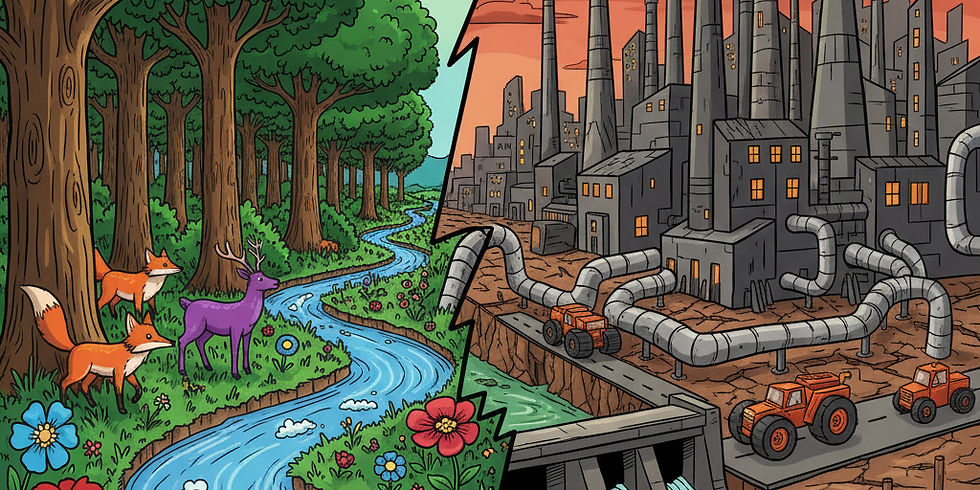
That's grim, but it's also, in a strange way, reassuring, because it implies that the wild places, the untouched ones, the reserves and the remote high valleys, remain a refuge. That somewhere out there, beyond the reach of our tractors and our streetlights, the old abundance still hums along.
A twenty-year study high in the mountains of Colorado, published in the autumn of 2025, quietly demolished that hope. In a remote, protected, undisturbed subalpine landscape, no farms, no pesticides, no development, about as close to pristine as anywhere gets, flying insect abundance had fallen by more than 70%. Seventy percent, in a place we hadn't touched.
The decline tracked, closely, with rising summer temperatures. Which means the thing killing the insects had followed them into the wilderness. There was no refuge after all, because the change had gotten into the air itself.
It's worth pausing on why any of this should trouble a person who has spent a lifetime cheerfully swatting the things. Insects are not, for most of us, objects of affection. We tolerate them at best.
But the reason their disappearance is so serious has nothing to do with whether we like them, and everything to do with the fact that they are the load-bearing wall of nearly every ecosystem on land, and load-bearing walls are precisely the things you cannot remove without discovering, too late, what they were holding up.
Consider what insects actually do, quietly, for free, every day, while we ignore them. They pollinate, roughly three-quarters of our leading food crops depend to some degree on animal pollination, and the overwhelming majority of that work is done by insects. They decompose; they are the clean-up crew that turns death and dung and fallen leaves back into living soil, and without them the world would, quite literally, fill up with its own waste.
They are food, the base of a pyramid that rises through the songbirds and the bats and the freshwater fish all the way to us. A vast proportion of the birds you love do not eat seeds; they eat insects, or they feed insects to their chicks, and where the insects go the birds follow, which is why the collapse of insect life and the thinning of the dawn chorus are not two stories but one.
Pull the insects out, and you are not removing a nuisance from the picture. You are removing the thing the picture is painted on.
This is the point where, in most of what I write, I'd turn to the money, and I'm not going to pretend that instinct isn't there, because the economics of this are real and vast. An economy is, when you strip away the abstraction, a thing that grows food and moves it and processes it and sells it, and all of that ultimately rests on ecological processes we have never paid for and have therefore never valued.
Pollination alone is worth hundreds of billions of dollars a year that appear on no balance sheet and are quietly assumed to be free and eternal.
When a foundation that enormous starts to shift, it does not stay an environmental story for long; it becomes a food-price story, a supply-chain story, an insurance story, a story about which assumptions built into the modern economy were never as solid as they looked.
The world has begun, tentatively, to notice this, the disclosure frameworks, the "nature-related financial risk," the growing recognition among central banks that an economy resting on a degrading natural base is an economy carrying an unpriced liability. I've written about that machinery before. It matters, and it's coming.
To value the insects only for what they do for us, to reduce a living, humming, four-hundred-million-year-old web of existence to a line item in a risk report. There is something in that framing that is part of the problem, and I don't want to reproduce it in the last paragraph of a piece about its consequences.

Because the honest truth is that the quiet world is a poorer one in ways that no balance sheet will ever capture. A summer evening with no insects in the low golden light is not merely economically risky; it is emptier. The clean windscreen is not just a data point in a decline; it is a small, banal monument to a world that is becoming less alive while we look at our phones.
We are, without ever quite deciding to, turning down the volume on the living planet, and the strangest, saddest part is how easy it has been not to notice, because silence doesn't announce itself, and absence makes no sound.
The insects were here for four hundred million years before us. They survived the asteroid that ended the dinosaurs. They will, in some form, almost certainly outlast us too. The question was never really whether life on Earth would continue, it will, with or without our particular branch of it.
The question is what kind of world we choose to live in while we're here, and whether we can bring ourselves to care about a catastrophe that arrives not with a bang but with a gradually cleaner windscreen and a quieter dawn.
I noticed mine was clean this summer. I hadn't, until then, noticed that I'd stopped noticing. And that, I think, is the whole thing in miniature, not that we decided the insects didn't matter, but that they slipped away so gently we forgot to grieve.
Listen, next time you're outside on a warm evening. Really listen.
Then ask yourself whether it used to be louder.
SEO Metadata
SEO Title: The Quiet World: The Insect Collapse Nobody's Talking About
Meta Description: Insects are vanishing — over 70% gone even in untouched wilderness. A reflection on the quiet collapse at the base of every ecosystem, and why the clean windscreen matters.
Focus Keyword: insect population collapse
Secondary Keywords: windscreen phenomenon, insect decline explained, insect apocalypse, why insects matter, biodiversity loss, sixth mass extinction insects
Tags: Nature & Biodiversity, Insects, Extinction, Ecosystems, Climate Change, Reflection
References
ScienceDaily / University of North Carolina at Chapel Hill - "Insects are disappearing from the last places we thought were safe" (Colorado subalpine study, Sept 2025): https://www.sciencedaily.com/releases/2025/09/250922074956.htm
NPR - "Insect populations drop even without direct human interference, a new study finds": https://www.npr.org/2025/09/12/nx-s1-5535551/insect-populations-human-interference-study
van Klink, R. et al., Science - global meta-analysis of insect abundance trends (~27% decline over 30 years): https://www.science.org/doi/10.1126/science.aax9931
Sánchez-Bayo, F. & Wyckhuys, K. (2019), Biological Conservation - "Worldwide decline of the entomofauna: A review of its drivers": https://doi.org/10.1016/j.biocon.2019.01.020
Binghamton University - "Insects are disappearing due to agriculture – and many other drivers" (2026): https://www.binghamton.edu/news/story/5513/
WWF - Living Planet Index (wildlife population declines since 1970): https://www.livingplanetindex.org/

Comments