The Most Important Machine Of The Next Decade Is A Very Big Battery (Grid-Scale Battery Storage)
Category: Energy Transition
The problem nobody mentions when they cheer for solar
Here's something that sounds like a joke but isn't.
The sun goes down every single night.

Obvious, I know. But sit with it for a second, because inside that childishly simple fact lives the single biggest problem in the entire clean energy transition, and, right now, one of the most interesting investment themes on the planet.
We've spent fifteen years cheering as solar and wind got astonishingly cheap. And they genuinely have, solar is now, by some measures, the cheapest source of electricity in human history. Brilliant. Triumphant. Every bit as good for the world as it sounds.
But there's a catch that the cheering tends to skip over, and it's a big one: the sun shines when it wants to, not when you need it.
Solar panels produce a flood of electricity at midday, when demand is often modest. Then, at about 6pm, when everyone comes home, switches on the oven, the telly, the heating, and (increasingly) plugs in the car, the sun clocks off for the day and solar production falls off a cliff.
So you have too much power exactly when you don't need it, and too little exactly when you do.
This is the problem. And the machine that solves it, the humble, unglamorous, enormously important battery, is having the most important year of its life. Let me explain why, and why it matters to you whether or not you ever buy a single share.
The tea-kettle problem
Let me make this concrete, because "grid intermittency" is the kind of phrase that makes eyes glaze over, and it shouldn't, because it's genuinely simple.
Think about your own home in the evening.
There's a famous phenomenon in Britain called "TV pickup." At the end of a hugely popular programme, or at half-time in a big match, millions of people get up at almost exactly the same moment and switch on the kettle. The surge in demand is so sudden and so enormous that the grid operators have to plan for it, they literally keep power stations on standby for the nation's tea.
Now scale that up to an entire country's daily rhythm. Every evening, demand spikes as the nation gets home. And every evening, at almost exactly that moment, solar power disappears with the sunset.
For a hundred years, we solved this by keeping fossil-fuel power stations, mostly gas, sitting there, ready to fire up the instant demand rose. They were the kettle-boilers of the nation. Flexible, on-demand, and dirty.
The whole game of the clean energy transition comes down to one question: what replaces the gas plant as the thing that delivers power exactly when it's needed?
And the answer, increasingly, is: a very, very big battery.
What a grid battery actually is
Forget the AA battery in your remote. Forget even the battery in your phone.
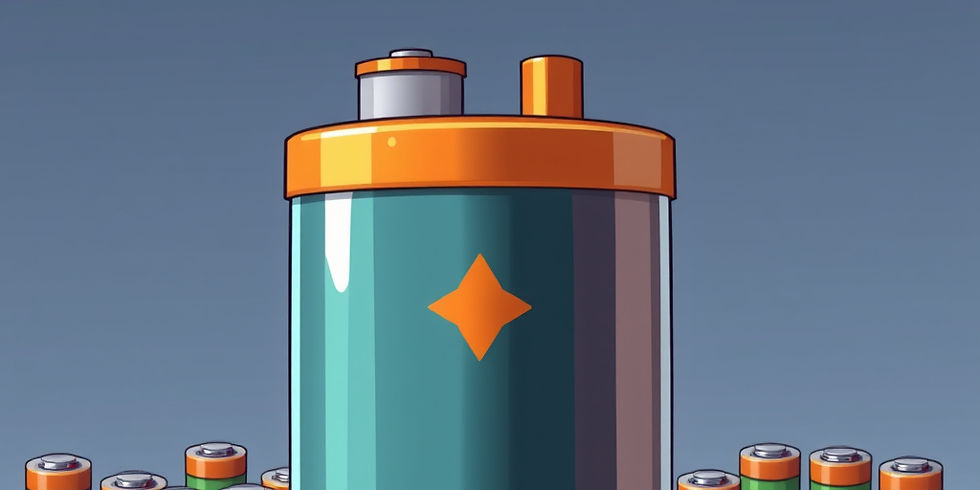
A grid-scale battery is a building. Or rather, a field full of what look like shipping containers, each packed with thousands of battery cells, sitting quietly next to a solar farm or a substation.
Its job is beautifully simple. It's a bucket for electricity.
When the sun is blazing at midday and producing more power than anyone needs, the battery fills up, soaking up the excess that would otherwise be wasted. Then, at 6pm, when the sun sets and the nation reaches for its kettles and its cars, the battery empties, releasing that stored power exactly when it's needed most.
It's a time machine for electricity. It takes power from the moment it's abundant and cheap, and moves it to the moment it's scarce and valuable.
That's it. That's the whole magic trick. And it turns out that this one simple function, shifting energy by a few hours, is the missing puzzle piece that makes a renewable grid actually work.
Because here's the thing that changes everything: a solar farm on its own is a part-time worker. A solar farm with a battery is a full-time one. The battery is what turns "cheap power sometimes" into "cheap power whenever you want it." And "whenever you want it" is the entire ballgame.
Why this year, specifically
Investment themes have a moment when they stop being a nice idea and start being a stampede. For grid batteries, that moment is happening right now, and the numbers are frankly startling.
Global battery storage capacity is projected to grow sixfold between 2025 and 2030, a compound growth rate of around 42% a year. (That projection, incidentally, was published the day before I wrote this. This is not old news; this is the news.)
In the United States alone, developers plan to add a record 24 gigawatts of new battery storage in 2026, up from 15 GW in 2025, which was itself a record.
Across the whole US grid this year, solar and batteries together are expected to make up nearly 80% of all new power capacity. Not a slice. The overwhelming majority.
In Europe, storage capacity has grown roughly tenfold in four years.
Do you see the shape of this? It's the chessboard from my earlier piece on compounding, the doubling that looks modest for a while and then goes vertical. Batteries have spent years as a rounding error in the energy system. They are now, suddenly, becoming a foundational pillar of it.
This is the knee of the curve, happening in real time.
And here's the detail I find most telling: roughly half of the battery storage now being added is built right next to solar farms, deliberately paired. The industry has stopped thinking of them as two separate things. Solar-plus-storage is becoming a single product, the part-time worker and the time machine, sold together.
The three forces shoving this forward at once

What makes a theme powerful isn't one tailwind. It's several, arriving together. And batteries have a genuinely rare alignment of them right now.
Force one: renewables need them more every day. The more solar and wind you build, the worse the intermittency problem gets, more gluts at midday, more cliffs at sunset. So every solar panel installed anywhere on Earth makes the case for storage stronger. Storage demand is, in effect, bolted onto the back of the entire renewables boom.
Force two: the AI electricity monster (remember him?). In an earlier piece I wrote about how AI data centres are straining the grid and demanding constant, 24/7 power. Batteries are one of the few things that can smooth those enormous, spiky demands. So the AI boom, a completely separate story, turns out to be also a battery story. Two unrelated stampedes, pointing at the same machine.
Force three: the price keeps collapsing. The cost of lithium-ion batteries has fallen relentlessly for over a decade, the same brutal, wonderful price war that came out of China's manufacturing dominance (another earlier piece, it's all connected). Cheaper batteries make more projects profitable, which drives more demand, which drives more manufacturing, which makes them cheaper still. A flywheel.
When three independent forces all shove in the same direction, you get the kind of growth curve the storage industry is now posting. That's not hype. That's just three trends colliding at the same address.
Now let me do the honest bit
This is the part where a lot of "green investing" writing gets irresponsible, so I'm going to slow right down.
A brilliant technology is not the same as a brilliant investment. I cannot say this often enough, and this is exactly the situation where people forget it.
Cast your mind back to my China piece. Solar panels conquered the world, and made a graveyard of many of the companies manufacturing them, because everyone piled in, built too much capacity, and competed each other into the ground on price. The technology won completely. Plenty of the investors lost badly.
Batteries carry the exact same risk. When a theme is this obviously attractive, capital floods in, factories get built, supply races ahead of demand, and prices - and profits, can crater even as the technology takes over the world. Being right about "batteries are the future" tells you nothing about whether any particular battery company makes money. Those are two completely different questions, and confusing them is one of the most expensive mistakes in investing.
There are real, specific risks here worth naming plainly:
Overcapacity and price wars, exactly as with solar.
Raw material dependence, lithium and other minerals, whose supply and price swing wildly, and whose mining carries its own serious environmental questions (a battery is clean in use, but the mine that fed it may not have been, an honest transition has to hold both thoughts).
Supply chain concentration in China, with all the geopolitical and tariff risk that brings.
Better technology arriving and making today's lithium-ion look obsolete, sodium-ion, flow batteries, and others are all circling.
None of that means the theme is bad. It means the theme is real and therefore crowded, and crowded is where people get hurt if they mistake a good story for a guaranteed outcome.
What I actually want you to walk away with
Not a stock. You know the rule by now, I don't know your circumstances, and anyone who hands you a ticker without knowing them is performing, not helping.
What I want to give you is a lens, and it's the same one every time: when you see a boom, ask what it physically requires to exist.
Everyone can see solar and wind. They're the glamorous, visible, cheerable part. Far fewer people stop and ask the boring follow-up question , "yes, but what happens when the sun goes down?", and then follow that question to the unglamorous machine that answers it.
That machine is the battery. It's the tea-kettle-boiler for a nation running on sunshine. It's the time machine that turns part-time clean power into full-time clean power. And it's genuinely, unambiguously good for the world, every gigawatt of storage is a gas plant that doesn't need to fire up, an evening of a nation's electricity that's clean instead of dirty.
It's also, precisely because it's so obviously attractive, a place where you'd want to think hard, move carefully, and never mistake a wonderful trend for an easy win.
The sun goes down every night. Working out what happens next - cleanly, reliably, and profitably - is one of the defining engineering and financial problems of our age.
The answer is a very big battery. Now you know why.
Next week: the metal that all of this quietly depends on - and the uncomfortable question of where it comes from.
References
pv magazine USA - "Global battery storage capacity projected to surge sixfold by 2030" (GlobalData, July 2026): https://pv-magazine-usa.com/2026/07/27/global-battery-storage-capacity-projected-to-surge-sixfold-by-2030/
U.S. Energy Information Administration (EIA) - Electric Power Monthly, 2026 capacity additions: https://www.eia.gov/electricity/monthly/
pv magazine USA - "Solar and storage to lead record-breaking 86 GW of new U.S. capacity in 2026": https://pv-magazine-usa.com/2026/02/25/solar-and-storage-to-lead-record-breaking-86-gw-of-new-u-s-capacity-in-2026/
SolarPower Europe - European Market Outlook for Battery Storage (January 2026): https://www.solarpowereurope.org/
Ember - "China Energy Transition Review 2025": https://ember-energy.org/latest-insights/china-energy-transition-review-2025/
IEA - "Batteries and Secure Energy Transitions": https://www.iea.org/reports/batteries-and-secure-energy-transitions

Comments