China Built A Century Of Cities In 40 Years. Then It Choked On The Bill. (China urbanisation and green energy)
Category: Global Challenges
A number that shouldn't be possible

Let me start with a fact that I still find genuinely hard to hold in my head.
In 1980, roughly one in five people in China lived in a city. Today it's roughly two in three.
That doesn't sound dramatic until you translate it into human beings. In the space of about four decades, China moved somewhere in the order of half a billion people from the countryside into cities.
Half a billion. That's more people than live in the entire United States, plus the United Kingdom, plus France, all packed into new apartments, in new cities, connected by new roads and railways and power stations, in less time than it takes a single person to go from birth to middle age.
Nothing on this scale has ever happened in human history. Not the Industrial Revolution, not the settling of America, nothing comes close. And I want to walk you through it properly, because it's simultaneously one of the most staggering achievements of the modern age and one of its great environmental cautionary tales and, right now, one of the most important economic stories on the planet.
All three at once. Let's take them in order.
Why a country builds cities in a hurry
First, why did this happen so fast? Because it was chosen.
Here's the logic, and it's worth understanding because it explains an enormous amount about the modern world.
When people move from a farm to a city, something economically magical happens: they become far more productive. A farmer growing enough food for their family produces a certain amount of value. That same person in a factory, or an office, connected to a global economy, can produce many times more.
Multiply that by hundreds of millions of people, and you get the fastest sustained economic growth in recorded history. China's cities became enormous engines, turning rural workers into factory workers into a middle class, and turning China from a poor agricultural country into the workshop of the world.
Think of it like this. A rural population is like a huge amount of potential energy sitting still, water held behind a dam. Urbanisation is what happens when you let it flow through a turbine. The economic electricity that produced was astonishing.
But, and here's where the story turns, when you build that fast, you don't stop to ask what it costs. You just build.
The bill arrives, and it's made of smog
Here's what building a century of cities in forty years actually requires.
It requires cement, and China poured more concrete in a handful of recent years than the United States poured in the entire twentieth century. Making cement is one of the most carbon-intensive things humans do.
It requires steel, made in vast quantities in furnaces mostly fed by coal.
It requires energy, enormous, relentless quantities of it, and for decades the cheapest, fastest way to get energy was to burn coal. So China burned coal. Staggering amounts of it. It became, by a wide margin, the largest carbon emitter on Earth.
And the bill for all of this arrived in the most visible way imaginable: the air.
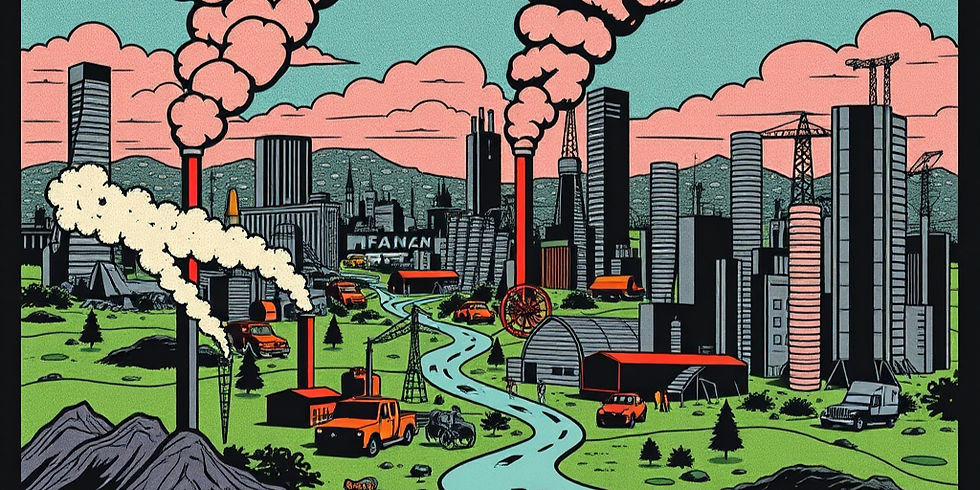
If you remember news footage from Beijing in the 2010s, you'll remember the smog, skies the colour of dishwater, people in masks, buildings vanishing into haze a few hundred metres away.
There were days when the air pollution in major Chinese cities was so severe it was, in effect, off the scale that instruments were designed to measure.
This wasn't an abstract "the environment" problem. It was a breathing problem. Hundreds of thousands of premature deaths a year, hospitals filling with respiratory illness, children kept indoors.
The environmental cost of the fastest urbanisation in history wasn't a polar bear on a distant ice floe. It was a person in Beijing unable to see the end of their own street, and coughing.
There was a water cost too, quieter but just as serious: rivers running black with industrial effluent, groundwater drained and contaminated, whole regions where the water was unsafe to touch, let alone drink.
This is the part of the story most people in the West still carry in their heads: China as the great polluter, coal-choked and careless.
And it was true. Which is exactly why what happened next is so remarkable, and so badly underappreciated.
The pivot almost nobody in the West has fully registered
Here's the thing that, if you take only one idea from this article, I want it to be this one.
The picture in your head is out of date.
Somewhere in the last decade, China looked at the bill, the smog, the deaths, the water, the sheer dependence on imported oil and coal, and made a decision that is now reshaping the entire planet's energy system. It decided to dominate clean technology. Not dabble in it. Dominate it.
And the scale of what it's done is, once again, hard to hold in your head. Let me give you the current numbers, because they're genuinely astonishing:
China now accounts for roughly a third of all clean energy investment on the entire planet, spending more than $600 billion in a single recent year.
Between 2019 and 2025, China invested more in clean energy than the rest of the world combined.
It controls somewhere between 80% and 95% of the global supply chain for solar panels. Not a lead, a near-monopoly.
In a single recent year, it added around 277 gigawatts of solar, a pace that means China has, at times, been installing roughly the equivalent of a large country's entire power grid, in additional solar, every few months.
Clean technology, solar, wind, batteries, electric vehicles, now makes up over 10% of China's entire economy. By one analysis, if you removed the clean-energy sector, China would have missed its national growth target.
Read that last one again, because it's the hinge of the whole story. Going green stopped being a cost China grudgingly paid. It became the growth engine itself.
Those unfamiliar car brands appearing on British roads? The cheap solar panels driving down energy costs across the developing world? The batteries in half the world's gadgets? That's not a coincidence. That's the deliberate result of the largest industrial strategy in modern history.
Why it went green (it isn't mainly about the planet)
Now, I want to be honest with you here, because the comfortable Western story, "China finally saw the light on climate", is mostly wrong, and the real reasons are far more interesting and far more instructive.
China went green for reasons that have very little to do with saving polar bears and everything to do with cold self-interest. And understanding those reasons tells you something important about how the world actually changes.
Reason one: energy security. China has limited oil and gas of its own. For decades it had to import enormous quantities, shipped across oceans it doesn't control, through chokepoints that a rival navy could close in a crisis. But the wind and the sun? Those fall on Chinese soil for free, forever, and no foreign power can blockade them. Renewables aren't just clean, they're sovereign. For a strategically-minded government, that's the real prize.
Reason two: the smog was becoming a political problem. A population that can't breathe is a population that gets angry. Cleaning the air wasn't charity; it was stability.
Reason three, and this is the big one: economic dominance. China looked at the twentieth century, where a handful of countries got rich controlling oil, and asked a simple question: what's the oil of the twenty-first century? Answer: the technology of clean energy. So it set out to own the manufacturing of it, the way Saudi Arabia owned oil wells, and largely succeeded.
Here's why I'm labouring this point. It would be easy to read all this and feel warmly about China's environmental conversion. That's not the lesson. The lesson is that the green transition happened fastest not where people cared most, but where going green aligned with hard national self-interest. That's not cynicism, it's the single most useful thing to understand about how big changes actually occur.
Virtue is a weak and unreliable engine. Self-interest, pointed in the right direction, is an unstoppable one.
(You may notice this is the exact same lesson as the carbon border tax, and the water crisis, and nature's missing price. It keeps being the lesson. That's not an accident.)
So where does the money come into this?
Right, this is a publication that connects the world's big stories to how ordinary people invest, so let's do that carefully and honestly.
The investment story here is genuinely fascinating, and genuinely razer-edged. I'm not going to tell you to buy anything, you know that by now, but I'll show you how to think about it, which is worth far more.

The bull case is straightforward. China has built a dominant, low-cost manufacturing position in the defining industrial technologies of the coming century. As the whole world electrifies, demand for solar panels, batteries and electric vehicles goes up, and China makes most of them.
Meanwhile, the global build-out this implies, grids, storage, transmission, raw materials, the metals that go into all of it, is a multi-decade wave of spending that has to happen almost everywhere.
But here is where you have to keep your wits about you, because there are three enormous catches, and anyone selling you the story without them is not being straight.
Catch one: dominance can become a weapon, which invites retaliation. When one country controls 80–95% of a critical supply chain, every other country gets nervous and starts building tariffs, trade barriers and subsidised competitors to reduce their dependence. That's already happening, and it directly threatens the profits of the dominant player. The strength is the vulnerability.
Catch two: winning the technology is not the same as winning the investment. This is the subtle one, and it's the one that catches people out. China won solar so completely that it built far more manufacturing capacity than the world could absorb, and the result was a brutal price war that made solar panels wonderfully cheap for humanity and financially painful for many of the companies making them.
A technology can conquer the world and be a graveyard for investors at the same time. Being right about the trend tells you almost nothing about whether any particular company makes money from it. (Remember: the people who got rich in a gold rush were frequently not the miners.)
Catch three: investing in China carries a category of risk that has nothing to do with the technology. Political risk, governance risk, the ever-present question of how much you can trust the numbers, and a geopolitical backdrop that can change the entire picture with a single policy announcement from Beijing or Washington.
These are real, they are large, and they are not the kind of risk you can research your way out of with a spreadsheet.
What I actually want you to take away
Not a stock. Never a stock. Something more durable than that.
I want you to update the picture in your head, because an out-of-date picture is the single most expensive thing an investor or a citizen can carry around. The "China equals coal and smog" image is a decade stale.
The reality is a country that is simultaneously still the world's biggest carbon emitter and the overwhelming force driving clean energy forward for everyone else. Both are true. Holding both in your head at once is the entire skill.
And I want you to notice the pattern that keeps recurring across everything I write: the world's biggest environmental shifts are being driven, in the end, not by conscience but by the moment when doing the right thing becomes the profitable thing, or the strategic thing, or the self-interested thing. Water, nature, carbon, and now the biggest industrial pivot on Earth, same engine every time.
China built a century of cities in forty years, choked on the bill, and then decided that cleaning up wasn't a cost to be endured but an industry to be owned.
Whatever else you think about it, that's the most important economic bet any country is currently making. It's worth understanding properly, before, not after, everyone else catches up to the fact that the picture changed.
Next in this series: the quiet mathematics of why the wealthy get wealthier in their sleep, and what an ordinary person can actually do about it.
References
Carbon Brief - "Analysis: Clean energy drove more than a third of China's GDP growth in 2025": https://www.carbonbrief.org/analysis-clean-energy-drove-more-than-a-third-of-chinas-gdp-growth-in-2025/
Ember - "China Energy Transition Review 2025": https://ember-energy.org/latest-insights/china-energy-transition-review-2025/
IEA - "World Energy Investment 2025: China": https://www.iea.org/reports/world-energy-investment-2025/china
Lombard Odier - "China's clean-tech revolution: global leadership and investment opportunities": https://www.lombardodier.com/insights/2025/november/from-coal-to-clean.html
Atlas Public Policy / Inside Climate News - "China Widens Its Clean Energy Lead": https://insideclimatenews.org/news/14052026/china-increases-clean-energy-investments/
Science - "China's urbanization at a turning point - challenges and opportunities": https://www.science.org/doi/10.1126/science.adw3443
DNV - "Energy Transition Outlook 2025: Greater China": https://www.dnv.com/energy-transition-outlook/2025/greater-china/
McKinsey Global Institute - "Preparing for China's urban billion": https://www.mckinsey.com/featured-insights/urbanization/preparing-for-chinas-urban-billion

Comments