The World Just Went Bankrupt. Not With Money, With Water.
Updated: Jul 20
Category: Global Challenges
Start with a bank account
Imagine you inherit a bank account with £100,000 in it.
Every year, someone pays £2,000 into that account. And every year, you take £5,000 out.

You feel fine. Rich, even. The card still works. The balance is still big. Nothing dramatic happens on any given Tuesday.
But you and I can both do the maths. You are spending more than you're earning, and the only reason it feels fine is that you started with a big pile. The pile is doing all the work of hiding the problem.
That is exactly, and I mean exactly, what humanity has been doing with fresh water. And in January this year, the United Nations effectively looked at the statement and said: the account is gone.
They used a word that made me sit up, because it's a finance word, not an environment word.
Bankruptcy.
Not "water shortage." Not "water stress." Global water bankruptcy.
I want to spend the next ten minutes explaining exactly what that means, why it's not the doom-scroll headline you think it is, and, the bit almost nobody connects, what it has to do with your money.
Part one: the difference between "a bad month" and "no money left"
Here's the distinction that makes this whole thing click, and it's one every person who's ever run a household budget already understands intuitively.
A shortage is a bad month. The car needed a new clutch, so this month is tight, and next month you're fine again. It's temporary. It's annoying. It corrects itself.
Bankruptcy is different. Bankruptcy means the money isn't coming back. You've spent the savings. The thing you were drawing down from is gone, and no amount of careful budgeting next month restores it.
When the UN says "water bankruptcy," it means that a huge number of the world's underground water stores, the aquifers, have been drained past the point where they refill.
And here's the part people genuinely don't know, so let me explain it properly.
The 10,000-year-old bathtub under your feet
Underneath much of the planet's farmland, there is water held in rock and sand, like water held in a giant, buried sponge. That's an aquifer.
Now, the thing everyone assumes is that rain refills it. Rain falls, water soaks down, sponge refills. Easy.
That's true for the shallow ones. But many of the aquifers we're farming from are what geologists call fossil aquifers, and the name tells you everything. That water got in there thousands of years ago, when the climate was completely different. In some places, the water we're pumping up to grow food today fell as rain when woolly mammoths were still walking around.
It refills at a rate somewhere between "unbelievably slowly" and "effectively never."
So when we sink a borehole into one of these and pump it out to irrigate crops, we are not using income. We are spending an inheritance built up over ten thousand years, and spending it in a few decades.
You can see why the UN reached for the word bankruptcy. That's not scaremongering. It's accounting.
Part two: "so what - I'm in Britain, it rains constantly"
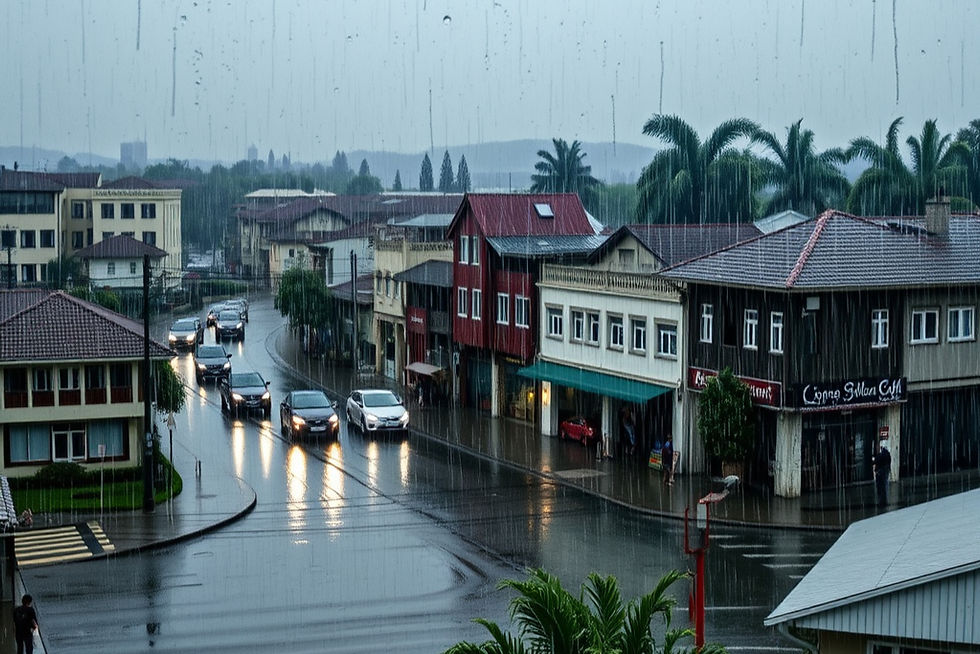
Fair. Genuinely fair. If you live in Bolton, the idea that the world is running out of water sounds ridiculous, because you were rained on twice yesterday.
So let me show you why this reaches you anyway. It reaches you through your dinner.
Here's a concept worth knowing, because once you see it you can't unsee it: virtual water.
Almost everything you buy contains water you can't see, the water it took to make it. Not the water in it.
The water used making it.
A single beef burger: roughly 2,400 litres of water to produce.
One cotton t-shirt: around 2,700 litres, enough drinking water for one person for about three years.
A cup of coffee: about 130 litres, once you count everything that went into growing the beans.
One almond: roughly one gallon of water. One almond.
You are not drinking that water. You're wearing it and eating it.
Which means when you buy a t-shirt, you have, without ever thinking about it, reached across the world and made a small withdrawal from someone else's aquifer. Probably in a country where water is scarce, because that's frequently where cotton is grown.
Britain doesn't have a water problem. Britain has an imported water problem. We buy most of our water from other countries without ever seeing it, because it arrives disguised as food and clothes.
That's why this isn't a "somewhere else" story. Roughly 3 billion people live in regions where water storage is already declining, and over half the world's food is grown in exactly those regions. Their aquifer problem becomes your supermarket price, quietly, with a delay, without ever being labelled as such.
Part three: the $58 trillion number
Here's where I have to put my old markets hat on, because there's a number in the UN's work that stopped me cold.
Fresh water, and the natural systems built around it, underpin roughly $58 trillion of economic activity a year, around 60% of global GDP.
Sixty percent.
Sit with that for a second, because it's genuinely strange when you think about it. More than half of everything the human race produces economically depends on a resource that, for most of history, we have treated as free, unlimited and not worth measuring.
Water is the most economically important substance on Earth, and we price it like it's nothing. We price bottled water higher than the water that grows our food.
And this is where I want to introduce you to an idea that, once you understand it, changes how you look at basically every market on the planet.
The mispricing
Markets are, in theory, price-discovery machines. Something becomes scarce, the price rises, the higher price makes people use less of it, and it also makes people invest in producing more of it or wasting less of it. That's the loop. That's the whole magic trick of a functioning market.
The loop only works if the price actually reflects the scarcity.
With water, it broadly doesn't. Economists studying this have been pointing at the same gap for years: because water is priced far below what its real scarcity would suggest, there's been far too little incentive to invest in fixing the problem, in efficient irrigation, in repairing leaking pipes, in recycling and treatment, in the deeply unglamorous plumbing that keeps civilisation running.
Here's the scale of what's not being funded: the World Bank estimates that around 113 low-income countries would need to roughly triple their current spending just to hit basic safe-water access targets. Meanwhile, drought already costs the global economy an estimated $307 billion a year, and by 2050, close to half of global GDP could be generated in areas of high water risk, up from about one in ten today.
So we have: an essential resource, running out, under-priced, underfunded, with a funding gap the size of a sector, and a cost of not fixing it that runs into the hundreds of billions annually.
If you've ever wondered what a structural investment theme actually looks like underneath all the jargon, that's what one looks like. Not a hot stock tip. A gap between what the world desperately needs to spend money on and what it currently spends money on.
What I am not saying
I want to be very careful here, because this is exactly the point where most content like this goes wrong and starts sounding like a sales pitch.
I am not telling you to go and buy water stocks. I'm not telling you to buy anything. I don't know your circumstances, your debts, your income, or your risk tolerance, and anyone who tells you what to buy without knowing those things is not helping you.
What I'm doing is more modest, and I think more useful.
I'm showing you how to see a theme. Because the skill that actually compounds over a lifetime isn't picking the right share, it's being able to look at a messy, complicated, real-world problem and work out where the money has to eventually flow to solve it. Water infrastructure, irrigation efficiency, desalination, leak detection, treatment and recycling: this is where the capital will have to go, because the alternative is that food gets more expensive and economies stop working.
Some of the companies doing that work will be excellent investments. Some will be terrible. Many funds with "water" in the name are, when you actually read the holdings, a strange grab-bag of things that have very little to do with the actual problem. Knowing the difference requires exactly the kind of digging that most people never do, and that's the skill I'd rather teach you than any individual name.
The bit that actually matters
Let me bring this back to where we started, with the bank account.
The reason "water bankruptcy" is such a useful phrase is that it forces us to think about nature the way we think about money: as an account with a balance, that can run out, that we are drawing from.
For most of human history, we could afford not to think that way. The pile was so big it hid the problem.
The pile is no longer big enough to hide the problem.
And here's the genuinely hopeful bit, which never makes the headlines: the capital needed to fix this already exists. This isn't a case of "we need to invent $700 billion from nowhere." The money is out there, sloshing around global markets right now, looking for somewhere to go. It's just currently pointed at other things, because nobody has priced this problem properly yet.
Which means the most powerful thing an ordinary person can do here isn't to feel guilty about their t-shirt. It's to understand the problem well enough to notice when the money starts moving, and to have a view on whether it's moving somewhere real, or somewhere that just has a nice green logo on the brochure.
That's what I'm here to help you do.
Next in this series, I'll take the same lens to the thing that's quietly straining every power grid on Earth: the electricity bill of artificial intelligence.
References
Madani, K. (2026). Global Water Bankruptcy: Living Beyond Our Hydrological Means in the Post-Crisis Era. United Nations University Institute for Water, Environment and Health (UNU-INWEH). https://unu.edu/inweh/collection/global-water-bankruptcy
UN News - "World enters era of 'global water bankruptcy'" (20 January 2026): https://news.un.org/en/story/2026/01/1166800
UN-Water - "UNU-INWEH report on 'Global Water Bankruptcy'": https://www.unwater.org/news/unu-inweh-report-global-water-bankruptcy
UK Parliament Commons Library - "What is 'water bankruptcy'?": https://commonslibrary.parliament.uk/what-is-water-bankruptcy/
Water Footprint Network - product water footprints (beef, cotton, coffee): https://www.waterfootprint.org/
World Bank - water sector financing and investment needs: https://www.worldbank.org/en/topic/water


Comments