Britain Sets £22 Billion On Fire Every Year, Sitting Still (The UK congestion cost)
Category: Public Policy
A very expensive way to do nothing
Let me describe a machine for you.
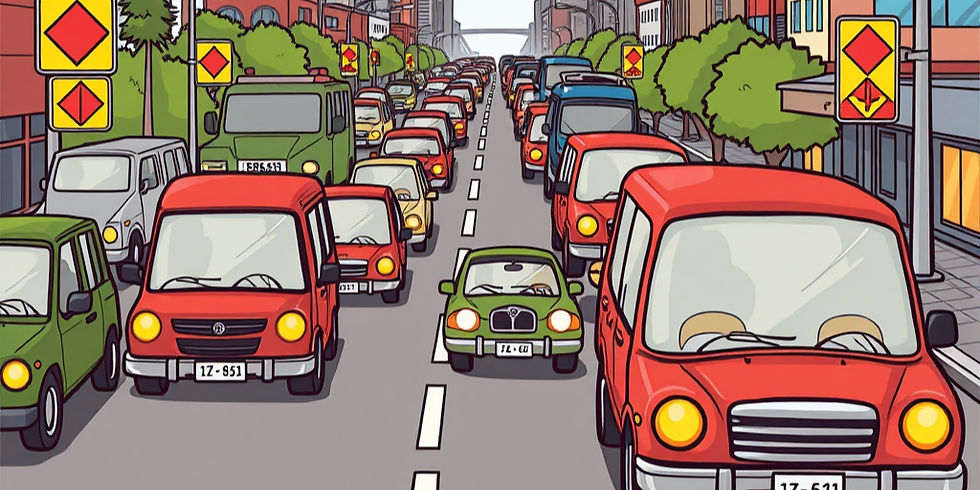
It takes twenty-two billion pounds a year of the nation's money, and it destroys it. Not steals it, destroys it.
The money doesn't go to a foreign government, or a tax dodge, or a failed project. It simply evaporates into thin air, and in return the country receives absolutely nothing.
Well, not nothing. It receives frustration, dirty air, and several million people quietly losing their minds in stationary cars.
The machine is British road congestion. And the genuinely maddening thing about it, the thing that made me want to write this piece, is that this is one of the rare enormous national problems where the cost of the problem is bigger than the cost of the solution, and we're choosing to pay the bigger number, year after year, mostly out of political cowardice.
Let me walk you through it. And then, because that's what we do here, let me show you where £22 billion of newly-freed money could go, and what tends to get built when a country finally decides to stop setting it on fire.
Part one: where the £22 billion actually comes from
Big round numbers are easy to disbelieve, so let's break this one open. It's really two separate piles of money, and they're worth understanding separately.
Pile one: the roughly £10 billion economic cost.
This is the productivity bleed. When a delivery van sits in traffic, that's a driver being paid to achieve nothing, a delivery arriving late, a customer let down. When a plumber spends ninety minutes crawling between two jobs that are four miles apart, that's an hour of billable work that simply never happens. Multiply that across every business in the country that depends on moving people or goods, which is, more or less, all of them, and you get a vast, invisible drag on the entire economy.
Recent estimates put UK congestion's cost at around £11 billion, with the average driver losing close to 60 hours a year, a full working week and a half, sitting still.
And here's the sneaky part: you pay for this even if you never drive. When a haulier's costs go up because their lorries are stuck, that cost gets passed into the price of everything the lorry was carrying. Congestion is a hidden tax baked into your weekly shop, whether you own a car or not.
Pile two: the roughly £12 billion of wasted household time.
This is the human pile. It's the parent who loses forty minutes a day they'll never get back, time not spent with their kids, not resting, not living. Economists put a monetary "value of time" on those lost hours, and when you add them all up across every commuting household in Britain, you get a number in the region of £12 billion a year of pure, vanished human life.
Put the two piles together and you're at roughly £22 billion a year. For comparison, that's not far off what the entire nation spends on the police. We are burning a police-force-sized amount of value annually, and the only thing we get for it is the privilege of staring at the bumper in front.
Part two: why "just build more roads" is a trap
The instinctive answer, the one every frustrated driver reaches for, is obvious. Build more roads. Widen the motorways. Add lanes.
It feels like common sense. It is, unfortunately, one of the most reliably wrong ideas in all of transport policy, and it has a name: induced demand.
Here's the concept, and once you see it you'll never unsee it.
Imagine a popular restaurant with a permanent queue out the door. You think: the queue is the problem, so let's make the restaurant bigger. You double the number of tables.
For a few weeks, the queue vanishes. Wonderful! But then something happens. All the people who used to avoid the restaurant because of the queue now hear it's easier to get in, so they start coming. Word spreads. Demand rises to fill the new space. And before long, you have a queue out the door again, except now it's a bigger restaurant with a bigger queue, and you've spent a fortune achieving the exact situation you started with.
Roads work identically. Add a lane to a congested motorway, and for a while it flows. But the easier journey tempts people who previously took the train, or travelled at off-peak times, or didn't make the trip at all. Traffic expands to fill the new road. Within a few years, you have a wider motorway that's just as jammed, and you've spent hundreds of millions to get there.
This isn't a fringe theory. It's one of the most robustly documented findings in the field. Building your way out of congestion is like trying to lose weight by loosening your belt. You've made room for the problem to grow, not solved it.
So if we can't build our way out, what actually works?
Part three: the solution nobody wants to say out loud
Here's the uncomfortable truth that transport economists have agreed on for decades, and that politicians run from as though it were on fire.
The reason roads are congested is that, at the moment of use, they are free. And when you make something valuable free, you get shortages, in this case, a shortage of road space, which we experience as a traffic jam.
Think about literally anything else that's in high demand at certain times. Hotels cost more in August. Flights cost more at Christmas. Electricity is being priced higher at peak times. We accept, everywhere else in life, that a scarce thing at a busy moment should cost more than an abundant thing at a quiet moment, because that pricing is what smooths out the rush.
Roads are the one glaring exception. A road into a city centre at 8:30am on a Tuesday, the single most contested strip of tarmac in the country, costs exactly the same as an empty country lane at midnight: nothing. So everyone piles onto it at once, and we all sit there together, furious.
The economists' answer is road pricing: charging more to use the busiest roads at the busiest times, and little or nothing the rest of the time. Not to punish drivers, to give them a signal, and a choice. Some journeys will shift an hour later. Some will switch to a bus. Some won't be made at all. And the ones that really matter, the ambulance, the tradesperson, the delivery that genuinely needs to happen at 8:30, get a road that actually moves.
We already have living proof this works, and it's sitting in our own capital.
Part four: the London experiment, and what it tells us
In 2003, London did the politically unthinkable and started charging drivers to enter the centre. The predictions of doom were deafening.
Here's what actually happened. Traffic entering the zone fell by around 10%. And, this is the part that matters most, the money didn't vanish into the Treasury. By law, the revenue is ringfenced and ploughed straight back into London's transport: buses, cycling, walking, road and bridge improvements.
Over a recent decade, more than a billion pounds went back into the system that way, the lion's share into buses.
There was a bonus nobody had promised: with fewer cars, there were roughly 30 fewer traffic collisions per month in central London, a 40% fall, with a matching drop in deaths and injuries. Stockholm and Milan ran similar schemes and saw the same pattern: less traffic, cleaner air, safer streets, and a pot of money to make public transport genuinely good.
That's the whole model in miniature. You price the scarce thing. The pricing eases the jam and generates a revenue stream. You spend that stream on the alternatives, so that the person priced off the road has a genuinely better option waiting. It's a loop, and it feeds itself.
Now, I want to be honest about the catch, because there's a real one.
Part five: the fairness problem, taken seriously
Road pricing has a genuine, serious objection, and anyone who waves it away is not being straight with you.
A flat charge hits a low-paid cleaner driving to a night shift exactly as hard as it hits a wealthy commuter, but the cleaner can far less afford it, and often has far worse public-transport alternatives, and far less flexibility over when they travel. Done carelessly, road pricing can become a tax that lets the rich buy their way onto clear roads while pricing the poor out of movement altogether. That's not a hypothetical; it's the central risk.
Which is exactly why the London lesson matters so much: the charge is only half the policy. The other half is what you do with the money. A road-pricing scheme that pockets the revenue is a stealth tax on the poor. A road-pricing scheme that pumps every penny into cheaper, faster, more reliable buses and trains is a wealth transfer towards the people who most need an alternative to their car. Same charge. Opposite outcome. The design is everything.
And this is where the timing gets interesting, because Britain is being forced to confront all of this whether it likes it or not, for a reason that has nothing to do with congestion.
Part six: the electric-car time bomb under the Treasury
Here's a problem hiding inside a good-news story.
As Britain switches to electric cars, which is genuinely excellent for air quality and carbon, the government has a growing hole in its accounts. A huge slice of Treasury revenue currently comes from fuel duty, the tax on petrol and diesel. Electric cars pay none of it.

So the more successful the switch to EVs, the faster tens of billions of pounds of annual tax revenue simply disappears. There's been serious speculation that the government will have to introduce some form of pay-per-mile charging for electric vehicles just to plug the gap.
And here's the accidental opportunity buried in that necessity. If you're going to build a national system that charges cars by the mile anyway, to replace fuel duty, you have, almost by accident, built exactly the machine you'd need for intelligent congestion pricing. Charge a little more for the busy road at rush hour, a little less for the quiet one at midnight.
The infrastructure the Treasury needs for one problem is the same infrastructure the country needs for the other.
Two problems, one solution. That's the kind of alignment that occasionally lets a country do something sensible almost by accident.
Part seven: so where does £22 billion go, and what gets built?
Right. Let's do the part we always do: follow the money. Suppose Britain finally grasped this and freed up even a meaningful fraction of that £22 billion, plus a road-pricing revenue stream on top.
What would it actually build, and where does opportunity tend to cluster when a country decides to unclog itself.
I'll say the usual thing first, because it matters: I'm not telling you to buy anything. I don't know your circumstances, and a stock tip from someone who doesn't is worthless. What I can do is show you where the money physically has to flow, because that's the durable skill.
Public transport, done properly. Britain is a strange outlier here. In Germany, around 90% of big-city residents have access to a tram or underground; in France, 80%; in Britain, under 20%, closer to the US than to our neighbours. Closing that gap means trains, trams, buses, signalling, electrification, a vast, multi-decade construction programme in the unglamorous hardware of moving people.
The digital layer. A pay-per-mile or congestion-charging nation runs on software, sensors, payment systems, number-plate recognition and data platforms. The physical toll booth is dead; the modern version is invisible and digital. Someone builds and runs all of that.
Active travel and the "15-minute" city. Cycling infrastructure, safer streets, and the redesign of towns so that daily needs are reachable without a car at all, the cheapest congestion fix of the lot, because the least-polluting journey is the one that was short enough not to need a car.
The electric vehicle ecosystem itself, the charging networks especially, the single biggest bottleneck to the EV switch, and a genuine build-out story.
And, the connective tissue, the grid upgrades, the batteries, the power infrastructure that a nation of electric vehicles requires. Which, you'll notice, is the exact same infrastructure I wrote about last week for entirely different reasons. It keeps being the same pipes. That's not a coincidence; it's the shape of the whole transition.
What I actually want you to take away
A way of seeing.
Congestion looks like a fact of life, like weather, like something you just endure. It isn't. It's a policy choice: the choice to give away scarce road space for free and then act baffled when it runs short. £22 billion a year is the invoice for that choice, and we pay it in productivity, in dirty air, and in slices of our own lives handed over to the traffic.
The frustrating, hopeful truth is that the solution is cheaper than the problem. The tools exist. London has run the experiment for over twenty years and the results are in. The electric-car revolution is about to hand us the perfect excuse to build the machine anyway.
What's missing isn't the money, the technology, or the evidence. What's missing is a government willing to say an unpopular true thing out loud, and design it fairly enough that people forgive them for it.
That's the whole story of Britain and its traffic jams: a £22 billion fire, a bucket of water sitting right next to it, and a nervous politician who won't pick the bucket up.
Understanding why they won't, and what happens the day one of them finally does, is where the interesting thinking, and eventually the interesting opportunities, quietly live.
Next week: the metal that all of this, the batteries, the grids, the electric cars, quietly runs on. And the deeply uncomfortable question of where it comes from.
References
The Conversation - "How the UK's dependency on cars slows down the economy" (December 2025): https://theconversation.com/how-the-uks-dependency-on-cars-slows-down-the-economy-270393
RoadXS - "The Cost of Congestion: The Impact of Transport Problems" (2025 figures): https://www.roadxs.com/insights/transport-problems/
INRIX - 2024 Global Traffic Scorecard (UK congestion cost and hours lost): https://inrix.com/scorecard/
UK Parliament, Transport Committee - "Road pricing" report: https://publications.parliament.uk/pa/cm5802/cmselect/cmtrans/789/report.html
C40 Knowledge Hub - "How road pricing is transforming London": https://www.c40knowledgehub.org/s/article/How-road-pricing-is-transforming-London-and-what-your-city-can-learn
Wikipedia - "London congestion charge" (2026 charge changes and revenue reinvestment): https://en.wikipedia.org/wiki/London_congestion_charge
Transform Scotland - "A new impetus behind road pricing?" (November 2025): https://transform.scot/2025/11/25/a-new-impetus-behind-road-pricing/


Comments