I'm Not Going To Pretend This Is Fine (AfD Saxony-Anhalt election)
Category: Public Policy
Let me drop the neutral voice for a moment
I try, in most of what I write here, to be even-handed. To lay out the arguments, respect the reader's intelligence, and let you reach your own conclusions. It's a discipline I believe in, and I'll return to it next week.

But not today. Today I'm going to be honest with you about how I actually feel, because I think pretending otherwise would be a kind of cowardice.
On the 6th of September 2026, the Alternative für Deutschland, a party formally classified by Germany's own domestic intelligence service as right-wing extremist, won a state election. In Saxony-Anhalt, the AfD took around 43.8% of the vote. More than double the centre-right CDU, the next party down, on roughly 17%. It is the first time since the end of the Second World War that a party of this character has topped a German state poll and stood on the genuine cusp of governing.
I am not going to dress this up in the careful, bloodless language that these stories usually get reported in. I find it appalling. I'm writing this piece angry, and I've decided not to hide that, because I think a certain amount of anger is the only sane response, and the steady drift toward treating this as normal, unremarkable political weather is part of how we got here.
Let me tell you why it matters, and then, because this is where my work usually lives, why it reaches all the way into the environmental future I spend most of my time writing about.
Read that phrase again
"Classified by domestic intelligence as right-wing extremist."
Sit with it, because the horror is in how easily the eye slides past it.
This is not me, a bloke with a website, slapping a label on a party I dislike. This is the assessment of Germany's own security services, an institution with more historical reason than almost any on Earth to understand exactly what it is looking at, and exactly where this particular road can lead.
A country that built its entire post-war identity around the solemn promise of never again has looked at this party, through the eyes of the very agency created to guard against the return of the past, and reached that conclusion.
And 43.8% of voters in Saxony-Anhalt looked at that same party and made it the largest in their state.
I want to be careful here, and precise, because it matters. I am not calling those voters extremists.
That would be lazy, wrong, and exactly the kind of contempt that feeds this whole phenomenon.
Most of them are ordinary people, frightened about the cost of living, furious at a political establishment they feel has ignored them for a generation, worn down and looking for anyone who seems to be listening. Their grievances are, in very many cases, entirely real and entirely legitimate.
That's what makes this so much harder, and so much more serious, than the comforting story where the bad guys are just cartoon villains. The tragedy of this result isn't that a lot of monstrous people voted. It's that a lot of ordinary, understandably angry people were persuaded to hand their anger to a movement that the state's own experts consider genuinely dangerous, because no one else convinced them they had a better answer.
The failure here belongs to the mainstream as much as to the fringe.
What this party actually wants
Let's not deal in vague adjectives. Let's look at the programme, because the specifics are what turn abstract unease into something you can properly be angry about.

The AfD's platform includes teaching the children of refugees in segregated classes. It includes banning rainbow flags in schools and replacing them with the national flag.
Key figures make frequent, well-documented trips to Moscow; the party opposes further support for Ukraine as it fights an invasion. Its officials have singled out Ukrainian and Muslim residents when discussing who they would like to see deported.
Segregated classrooms for children based on where their parents came from. In Germany.
In 2026. I'm not going to pretend a sentence like that is just one more policy position to be weighed dispassionately against tax rates. There are things a liberal society should be able to call wrong without a hundred qualifications, and the deliberate separation of children by origin is one of them.
The canary and the coal mine
Here's why this isn't only a German story, and why I think it should worry you wherever you're reading this.
Germany was supposed to be the firewall. Of all the countries in Europe, it was the one whose history was meant to make it most resistant, the one place where the lessons had been most thoroughly learned, the institutions most carefully built, the cultural taboo most deeply set.
If the wall is cracking there, of all places, then the comforting idea that "it couldn't happen here", wherever your here is, deserves a great deal less confidence than most of us have been giving it.
This is not an isolated German spasm. It's one data point in a pattern visible right across the democratic world: the steady, grinding rise of hard-right populist movements, feeding on the same fuel everywhere, economic insecurity, a sense of being unheard, fear of change, and a political mainstream that has too often responded with either managerial blandness or outright contempt.
The specifics differ country to country. The shape does not.
And the mechanism should genuinely frighten you, because it's so mundane. This is how the previously unthinkable becomes normal: not in one dramatic lurch, but by inches.
Each result a little worse than the last. Each one greeted with a little less shock. The window of what's acceptable to say, to propose, to do, dragged slowly in one direction until things that would have ended a career a decade ago are simply Tuesday. We are, I think, being boiled slowly, and the water is getting warm.
Where this hits the environment - and it hits it hard
Now let me connect this to the work I usually do, because the link is direct, concrete, and badly under-discussed.
The AfD is not merely sceptical of climate action. It is openly, programmatically hostile to it. The party explicitly wants to halt Germany's Energiewende, its entire energy transition, one of the most significant decarbonisation projects in the world. It campaigns relentlessly against wind power.
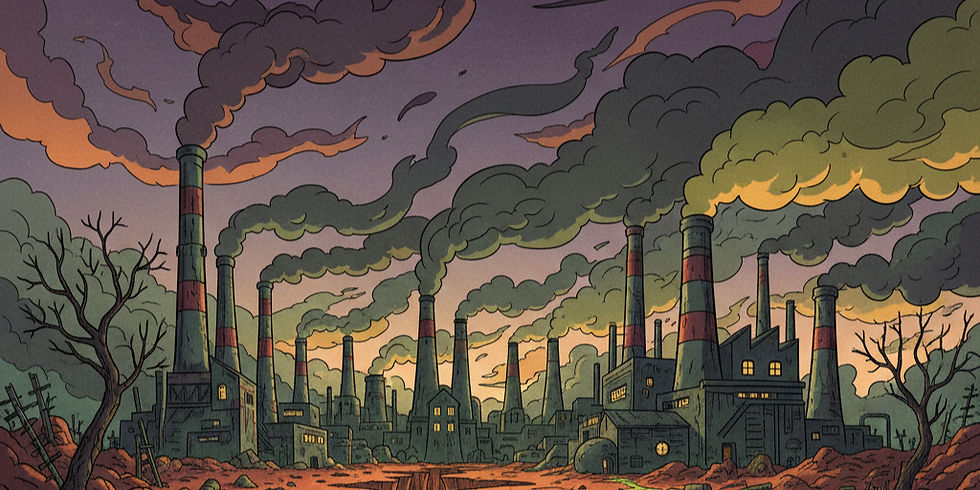
It has fought, at regional level, to effectively ban wind turbines in forests. It defends coal and diesel. Some of its senior figures flirt openly with outright denial of human-caused climate change.
And this isn't fringe noise with no effect. Research from earlier this year found that support for the AfD is the single strongest predictor of opposition to renewable energy in Germany, stronger than income, stronger than age, stronger than any other factor measured.
Where this party rises, the resistance to the green transition rises with it, mechanically.
Here is the part that should sober up anyone who cares about the climate fight. We have spent years being told the transition is fundamentally an engineering problem, build the batteries, scale the solar, fix the grid. It isn't, or at least not only. It is a political problem, and the German result is a flashing red warning of exactly how the whole thing can be derailed.
You can have the cheapest solar in history, the best battery technology, a genuinely workable path to a cleaner economy, and none of it matters if a political movement rises that decides the whole project is an elitist con to be torn up for votes.
The technology doesn't implement itself. It requires stable, sustained political will across many years, and that will is precisely what movements like this exist to shatter. Climate action needs continuity. Extremism thrives on rupture. They are natural enemies, and last weekend rupture won a state.
There's a bitter irony threaded through all of it, too. Many of the economic anxieties driving people toward the AfD, energy bills, the cost of living, the fear of being left behind, are worsened, not helped, by abandoning the transition to cheap renewable power.
The anger is real.
It is being harvested by a movement whose actual energy policy would, over time, make the very hardship that fuels it worse. That's the trap, and it's a cruel one.
Take-away time...
Not despair. Anger, maybe, I've made no secret of mine, but not despair, because despair is just another way of giving up, and giving up is exactly what gets us the future these movements are selling.
What I want is for you to refuse the slow boil.
To decline the invitation to treat each of these results as normal, as background noise, as just how things are now. They are not normal. A party the German state considers extremist winning a German state is not normal, and the day we shrug at it is the day the wall comes down for good.
I spend most of my time here writing about the future, about how we power it, feed it, invest in it, and hopefully hand it on in a better state than we found it.
And I'll be back to the numbers and the calm analysis next week, because that work matters too.
But none of it, not the clean energy, not the water security, not the careful, hopeful building of a better world, none of it survives contact with a politics of rage, scapegoating and rupture. The environmental fight and the fight for a decent, liberal, humane politics are not two separate battles.
They are the same battle. You cannot win one while losing the other.
So no. I'm not going to pretend this is fine.
It isn't.
And the first, most important act of resistance is simply refusing to say that it is.
References
Al Jazeera - "German far-right AfD wins Saxony-Anhalt election, falls short of majority": https://www.aljazeera.com/news/2026/9/6/far-right-afd-wins-vote-in-germanys-saxony-anhalt-state-exit-polls
CNN - "Germany election results: Far-right AfD win historic victory, but fall short of majority to rule Saxony-Anhalt": https://www.cnn.com/2026/09/06/europe/germany-afd-state-election-majority-intl
CNBC - "Germany's far-right AfD seeks landmark state victory": https://www.cnbc.com/2026/09/06/germanys-far-right-afd-seeks-landmark-state-victory.html
Clean Energy Wire - "Far-right AfD shifts debate on German climate policy, but lacks real say": https://www.cleanenergywire.org/news/far-right-afd-shifts-debate-german-climate-policy-lacks-real-say-researcher
Diermeier, M. et al. (2026), German Politics - "Explaining Attitudes Towards Climate Action in Germany: AfD vs. the Greens..." (AfD support as strongest predictor of renewable opposition): https://www.tandfonline.com/doi/full/10.1080/09644008.2025.2587229
Clean Energy Wire - "Populist AfD 'sand in the gears' of German climate efforts": https://www.cleanenergywire.org/news/populist-afd-sand-gears-german-climate-efforts


Comments