There Is Plastic In Your Brain. Let's Talk About It Calmly.
Updated: Jul 17
Category: Environmental Science
A sentence I did not expect to write
In April this year, researchers published a study in Nature Health. They examined human brain tissue, real brains, from real people, and looked for tiny fragments of plastic.
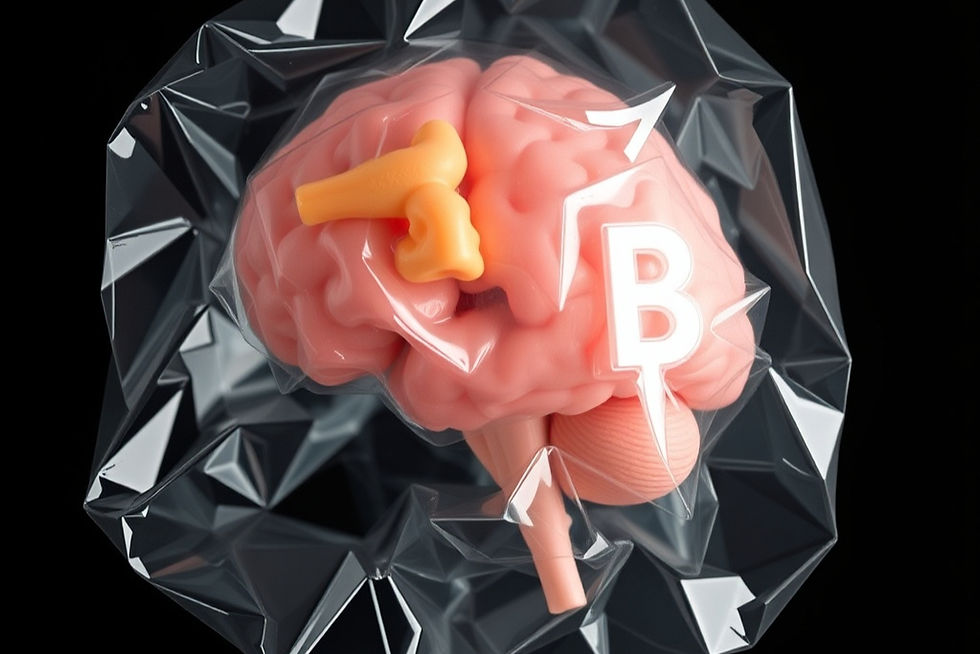
They found them in nearly every single sample.
Not just in people who'd worked in chemical plants. Not just in the sick. In healthy brain tissue, from ordinary people, who had done nothing more unusual than live a normal modern life.
Now, my instinct when I read a headline like that is to be suspicious, and I'd encourage you to have exactly the same instinct. The internet is full of health scares engineered to frighten you into buying a supplement.
So let's do this properly: what was actually found, what it actually means, what's being wildly overstated, and, because this is what I do, what it tells us about how the world's money is about to move.
Part one: what is a microplastic, really?
Let's build this from the ground up.
Plastic doesn't biodegrade. That's the whole point of it, it's the property that makes it useful. A plastic bottle doesn't rot the way an apple core does, because no bacteria evolved to eat something that didn't exist until the 1950s.

But plastic does break. Sunlight, heat, friction and time gradually shatter it into smaller and smaller pieces. It doesn't disappear. It just becomes confetti.
Think of a sandcastle. If you smash it, you don't destroy the sand, you just have smaller pieces of the same sand. That's what happens to every piece of plastic ever made. It gets smaller. Forever.
Microplastics are pieces smaller than 5mm, down to specks you'd need a microscope to see.
Nanoplastics are smaller still. Absurdly small. Small enough to slip through biological barriers that are designed to keep things out.
And that last point is the whole ballgame, so let's spend a moment on it.
The bouncer at the brain's front door
Your brain is the most protected organ you have. It sits behind something called the blood-brain barrier, a filter so selective that it's one of the great frustrations of modern medicine. We have drugs that would work brilliantly on brain conditions, and we can't get them past this barrier. It's an incredibly effective bouncer.
The point of the bouncer is simple: keep foreign objects out of the brain.
The finding in that April study is that nanoplastics are getting past the bouncer.
And the researchers found something specific and rather telling: the smallest particles, the nanoplastics, were more abundant in brain tissue than the larger microplastic fragments.
Which makes perfect, slightly horrible sense. The big ones can't get in. The tiny ones can. So the brain ends up preferentially collecting the smallest, sneakiest ones.
Part two: this is not one weird study
Here's the thing that moved this from "huh, interesting" to "we should probably pay attention" for me.
The brain study isn't a lone finding. It's the latest entry in a sequence that's been building for years, as researchers have gone looking, organ by organ:
Blood - found in the majority of healthy adults tested. Confirming these particles don't just pass through the gut; they enter circulation.
The placenta - meaning exposure begins before birth. That one genuinely stopped me.
Lung tissue - we're breathing them, not just eating them.
Breast milk.
Artery plaque - the fatty deposits in blood vessels.
And now, the brain.
Any one of those, on its own, could be a fluke or a contaminated lab sample. All of them, in sequence, from independent teams, across nearly every organ system anyone has thought to check?
That stops being a curiosity. That becomes a fact about modern human biology.
Part three: now let me talk you down a bit
This is the part most articles skip, and it's the part that matters most for your ability to think clearly.
The study found a correlation, not a cause. Plastic concentrations were higher in tumour-affected brain tissue than in healthy tissue. That is not the same as saying plastic causes brain tumours. It's genuinely not.
There are several possible explanations, including the perfectly plausible one that damaged, inflamed tissue is simply leakier, and therefore accumulates more of everything, plastic included. Cause and effect could easily run backwards from what the scary headline implies.
The researchers themselves have been careful about this. Good scientists usually are. It's the people summarising them who aren't.
And some of the coverage was straightforwardly wrong. You may have seen a viral claim that there's "a spoonful of plastic in your brain." That comparison substantially overstated what the research actually found. It got shared millions of times because it's a brilliant, sticky image, and that's precisely why you should be suspicious of it.
Here's a rule worth carrying with you for life: when a scientific finding gets a memorable metaphor attached to it, check whether the metaphor came from the scientists or from someone trying to get clicks. It's almost always the latter.
The honest position is this: we have found plastic in places it absolutely should not be, in nearly everybody, and we do not yet know what it does to us long-term. That's concerning enough. It doesn't need embellishment, and embellishing it actually damages the case, because when the exaggeration gets debunked, people dismiss the real finding along with it.
Part four: where it's actually coming from (this surprised me)
Ask most people where they're getting microplastics from and they'll say "fish" or "the ocean."
The evidence points somewhere far more boring and far closer to home. The biggest identified sources of human exposure are:
Bottled water. Consistently one of the largest single contributors. The bottle sheds into the water, especially if it's been sitting in a warm warehouse or a hot car.
Food packaging.
Synthetic textiles - your fleece, your polyester bedding, shedding fibres into the air in your own home, which you then breathe.
Heating food in plastic containers. Heat dramatically accelerates shedding. That microwave meal in the plastic tray is, in exposure terms, one of the worst things in the average person's week.
Notice what's happening here. The exposure isn't coming from some distant industrial catastrophe. It's coming from the ordinary, convenient, entirely legal objects in your kitchen.
Which is, in a way, the whole story of plastic: it's not that anyone did anything wicked. It's that we built modern life around a miracle material without asking where it ends up.
Part five: the money angle nobody's connecting
Here's where my two worlds collide, and where I think this gets genuinely important rather than just alarming.
Consider what happened with asbestos, or leaded petrol, or tobacco. In each case, the pattern was identical:
A useful, profitable, ubiquitous material.
Early scientific signals that it might be harmful, dismissed, contested, under-funded.
Evidence accumulating slowly, organ by organ, study by study.
A tipping point where the evidence became undeniable.
Then: regulation, litigation, and an enormous, rapid repricing of every company connected to it.
Step five is not gentle. It is not gradual. Whole industries have been reshaped in a handful of years once the tipping point arrives.
Now, I want to be careful. I am not predicting that plastic is the next asbestos, and I'm not telling you to short plastic companies. That would be a genuinely stupid thing to say, and I don't know how this resolves.
What I am telling you is that the pattern is worth recognising, because it's one of the most reliable patterns in all of financial history. When a material that's embedded in everything starts accumulating an evidence base that it harms people, the risk to the companies built on that material does not stay theoretical forever.
Plus the flip side is more interesting: capital is already moving toward alternatives, bio-based materials, advanced filtration and water treatment, packaging redesign, textile innovation. Some of it is genuine. A great deal of it, as ever, is marketing.
The skill isn't picking the winner. The skill is understanding the science well enough to tell which is which, and to know that a company slapping "eco" on a bottle is not the same as one solving the problem.
What I'd actually do tomorrow morning
Panic is useless. It's also unwarranted. But there are a handful of changes that are cheap, easy, and supported by the strongest part of the evidence base:
Stop heating food in plastic. Glass or ceramic in the microwave. This is the single highest-impact, lowest-effort change available, because heat is the accelerant.
Filter tap water rather than drinking bottled. In the UK, tap water is excellent, cheaper, and, on current evidence, lower in plastic than bottled.
Glass or steel for food storage. Especially for anything hot, fatty or acidic, which strips particles faster.
None of this eliminates your exposure. The researchers are candid that contamination is now too widespread for that. But these are the specific interventions with the best evidence behind them, and they cost you almost nothing.
The honest summary
We spent seventy years building the entire physical furniture of modern life out of a material we're now finding in human bloodstreams, placentas, arteries and brains.
That's not a reason for despair, and it's certainly not a reason to buy anything from anyone frightening you about it.
It's a reason to pay attention, carefully, sceptically, and with your eyes open, to a story that is going to get considerably bigger, and to understand it before it becomes obvious to everyone else. Because by the time the tipping point arrives, the thinking will already have been done, and the only question left will be whether you were paying attention.
Next in this series: how to read a scientific study without being fooled - including why one in every 277 papers now cites research that doesn't exist.
References
Li, R. et al. (2026). "Microplastics and nanoplastics in brain tumours and the healthy human brain." Nature Health. DOI: 10.1038/s44360-026-00091-4
Medical Xpress - "Microplastics turn up in nearly every human brain sample, including healthy tissue": https://medicalxpress.com/news/2026-04-microplastics-human-brain-sample-healthy.html
Nature World News - "Plastic in the Brain: Landmark 2026 Study Finds Microplastics in Nearly Every Human Brain Sample": https://www.natureworldnews.com/articles/73034/20260624/plastic-brain-landmark-2026-study-finds-microplastics-nearly-every-human-brain-sample.htm
Microplastics journal (2026) - "Microplastics and Nanoplastics in Human Health: From Environmental Contaminants to Internal Pollutants": https://doi.org/10.3390/microplastics5030131
Leslie, H. et al. - "Discovery and quantification of plastic particle pollution in human blood," Environment International: https://doi.org/10.1016/j.envint.2022.107199
Marfella, R. et al. - "Microplastics and Nanoplastics in Atheromas and Cardiovascular Events," New England Journal of Medicine: https://www.nejm.org/doi/full/10.1056/NEJMoa2309822
Comments